Let's TalkContact me!
Work About Lab Resume Let's Talk
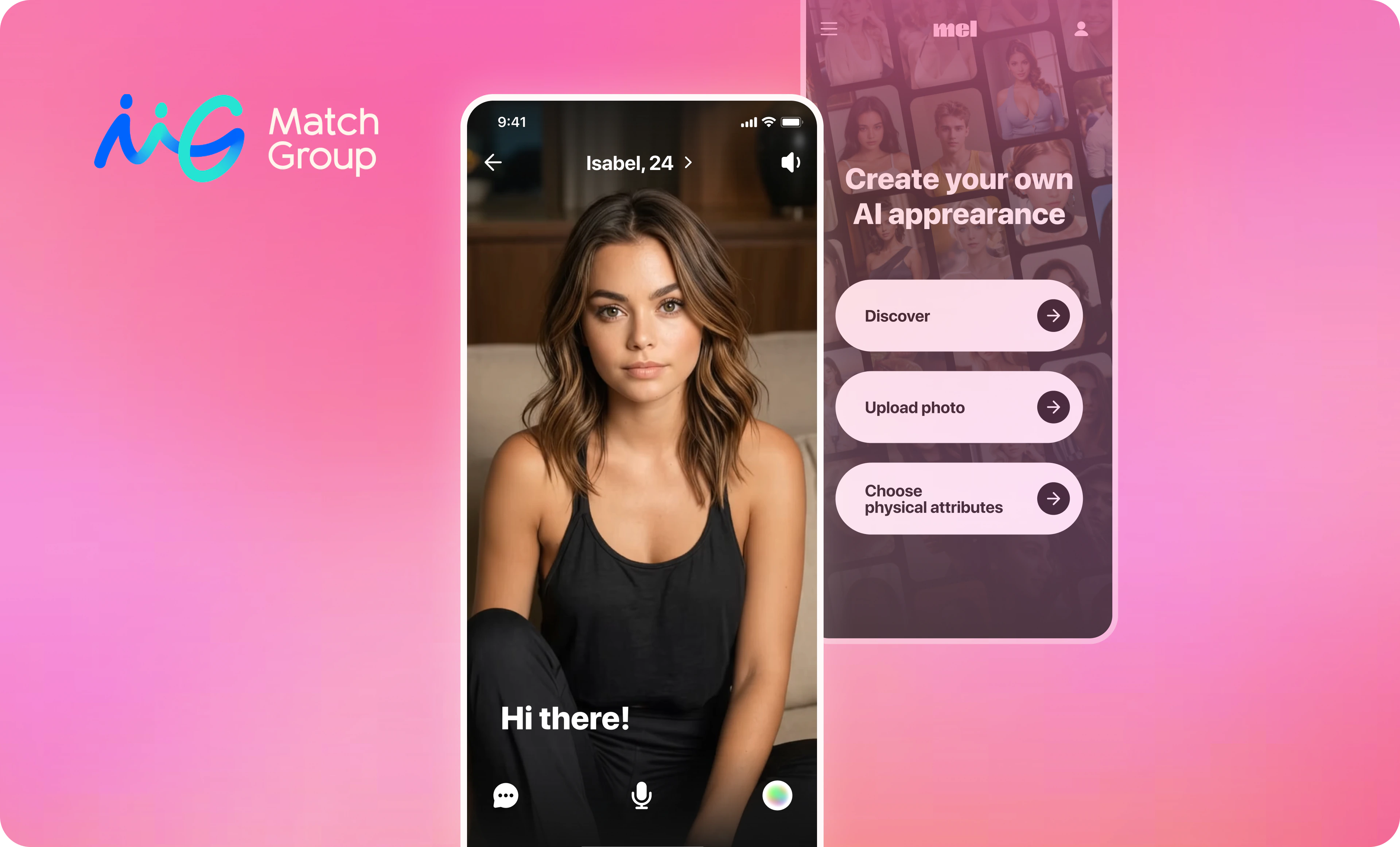
Mel AI video dating app screens on a Match Group cover
AI-Native Dating Conversation Business Impact

Designing an AI Dating Experience for Longer,
More Engaging Conversations

Redesigned Interactive Mode to make it easier to discover and sustain AI conversations,
increasing entry by 5× and average conversation time by 5.5×.

MY ROLE

Product Design
Interaction Design
Design System
UX Research
Prototyping

TIMELINE

Apr 2024 - Jul 2024

TEAM

2 Product Designers (Me)
1 Product Owner
2 Product Managers
6 ML Engineers
8 iOS/Android/Web Engineers

TOOLS

Figma
After Effects
Photoshop

OVERVIEW

From the makers of Tinder: making AI dates easier to start and keep going

Match Group, the company behind Tinder, Hinge, and Match, explored an AI dating experience where users build ongoing relationships with AI companions. I joined as a product designer in the early, pre-launch stage, designing Interactive Mode, where users go on role-play dates with their AI instead of just chatting.

Through user testing and behavioral data from 1,000+ users, we found two challenges: users couldn't find the mode during a call, and those who entered didn't know what to say next. I redesigned the experience to make AI dates easier to start and easier to keep going, driving a 5× increase in Interactive Mode entry and a 5.5× increase in average conversation time.

Mel app icon
CONTEXT
ABOUT MATCH GROUP

The world’s leading dating company behind Tinder and Hinge

Match Group is the #1 global online dating company behind brands like Tinder and Hinge. Its portfolio serves different relationship needs and audiences, with a shared mission to help people build meaningful connections through technology.

Couples laughing together, with the Tinder logo
WHAT IS MEL?

Mel brings AI dates to life for Tinder users tired of swiping

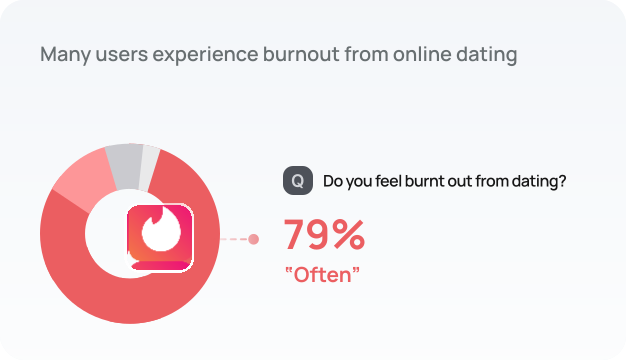
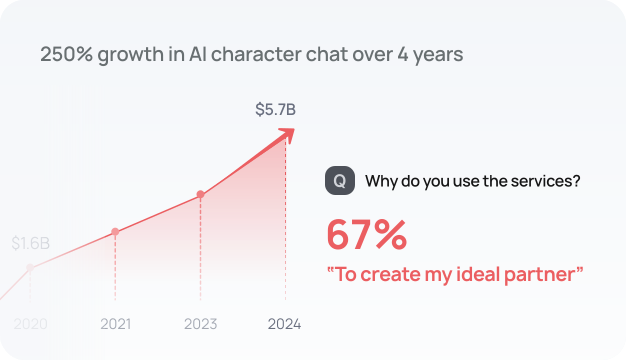
Tinder lost 100,000 subscribers after the pandemic, and 79% of daters said they often feel burnt out by the effort of finding a meaningful match. Meanwhile, AI character chat grew 250% in four years, and many users were already treating AI characters as romantic partners. 67% said they used these services to create their ideal partner. These relationships lived only in text. We created Mel, an AI video dating service that brings users' ideal partners to life through realistic video calls.

Pie chart: 79% of users often feel burnt out from dating
Studies Show Modern Daters Are Experiencing Swiping Fatigue & Burnout - Dating Advice.com (2024. 01)
AI character chat market grew from $1.6B in 2020 to $5.7B in 2024; 67% use it to create their ideal partner
Love in the Age of AI Dating Apps : 2024 Statistics - TIDIO (2024. 03)
BEHAVIORAL INSIGHT

Users who talked the longest didn't want realism. They wanted role-play.

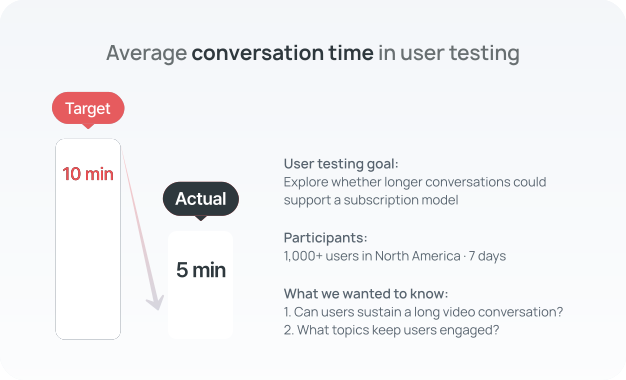
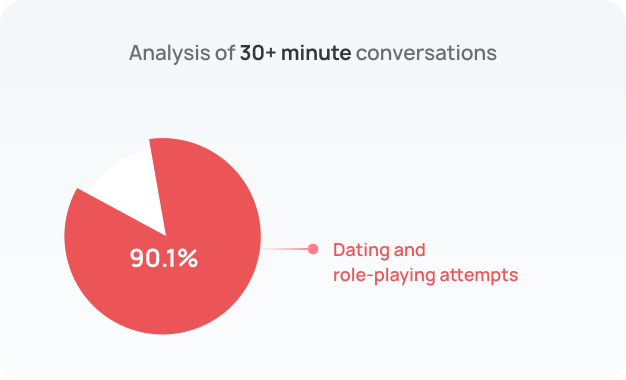
To validate the potential of a subscription model, we tested whether users could sustain 10-minute AI video calls. The average call lasted only 5 minutes, as many didn't know what to talk about. But among users who talked for over 30 minutes, 90.1% used role-play and imagined dating scenarios.

Average conversation time in user testing: 10 min target vs 5 min actual
Analysis of 30+ minute conversations: 90.1% were dating and role-playing attempts
PRODUCT OPPORTUNITY

Turning users' role-play into AI dates with ‘Interactive Mode’

Rather than making the AI more realistic, we decided to support what users already wanted. We designed Interactive Mode, where users go on role-play dates with their AI, like "You're a rock star and I'm your fan."

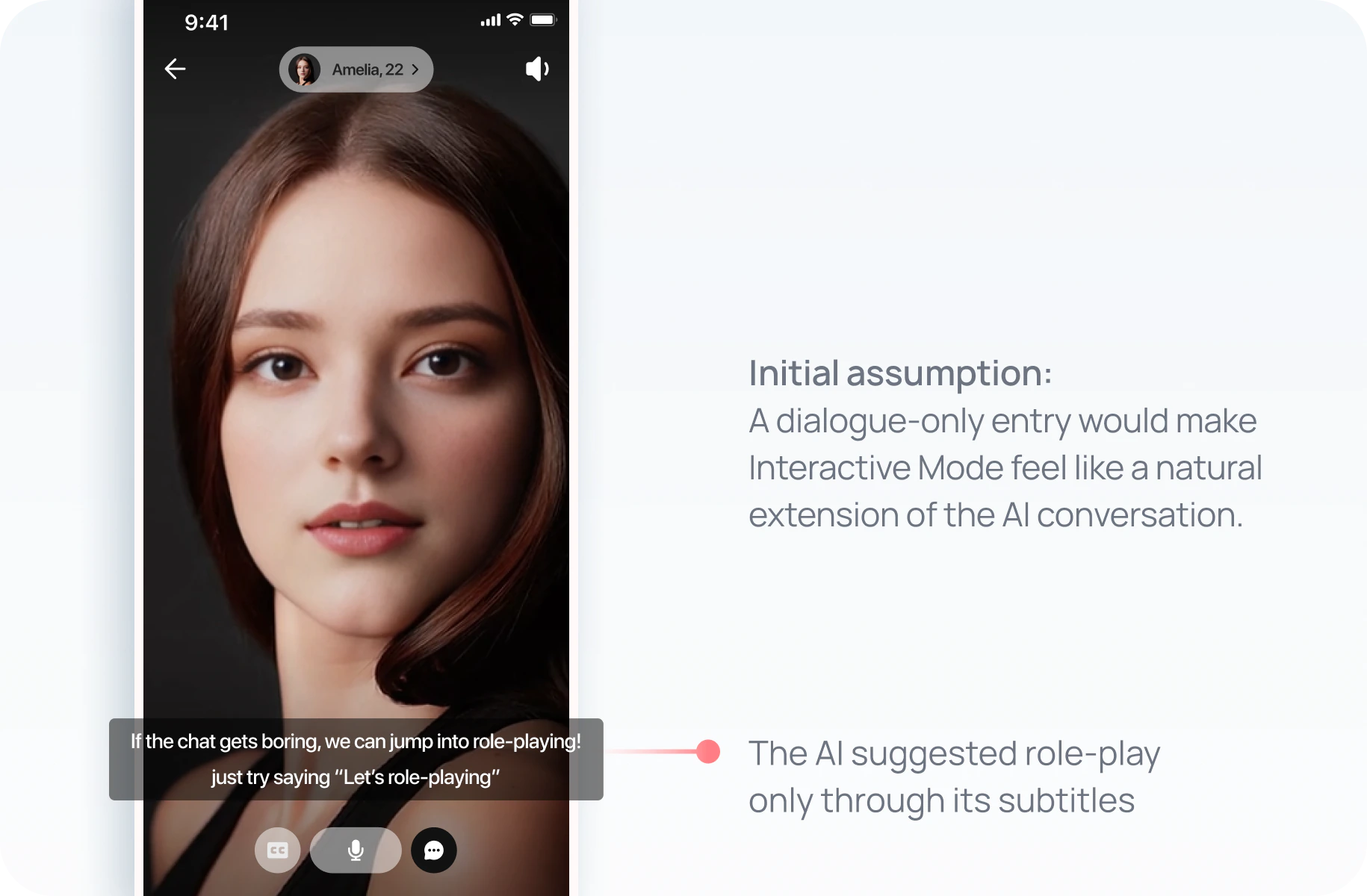
Our team’s vision was a natural, seamless conversation, so we initially used dialogue-only entry into Interactive Mode rather than UI guidance.

Initial dialogue-only entry: the AI suggested role-play only through its subtitles
THE CHALLENGE

Only 13.3% of users found Interactive Mode, and even they ran out of things to say

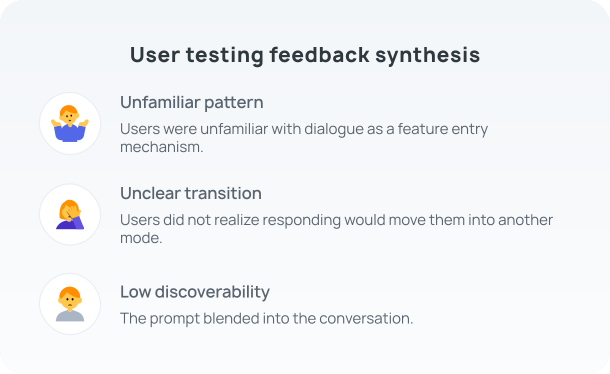
However, in user testing, most users didn't recognize the AI's suggestion as a way in. Those who did enter often paused, unsure what to say next.

User testing feedback synthesis: unfamiliar pattern, unclear transition, low discoverability
GOAL

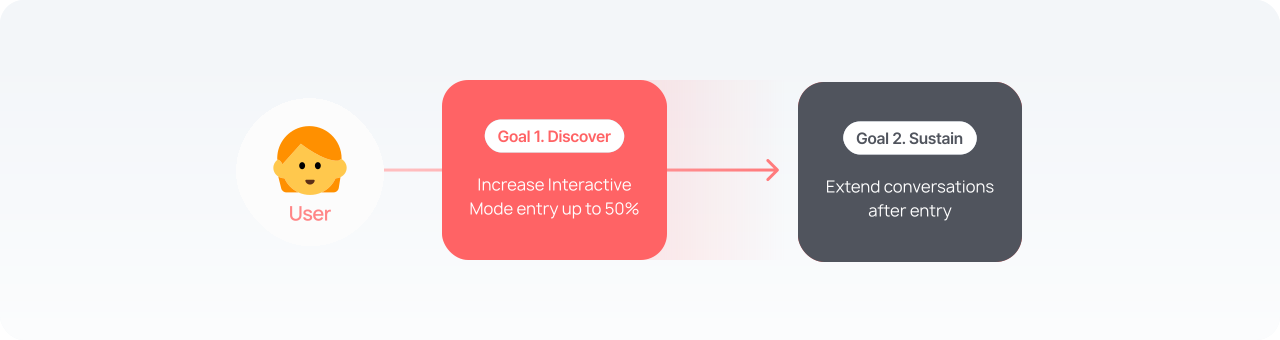
Increase Interactive Mode entry to 50% and extend conversation time

As Interactive Mode was both the service’s core feature and the foundation of its business model, our primary goal was to help at least half of call users enter the mode. Our secondary goal was to extend conversation time through continued interaction.

Goal 1. Discover: increase Interactive Mode entry up to 50%. Goal 2. Sustain: extend conversations after entry
EXPLORATION

Aligning product direction, user experience, and technical feasibility

Working with PM, design, and ML/engineering, we aligned user needs with product goals and technical constraints to define three design directions.

01 ENTRY

Make entry visible without disrupting the conversation

Product need
Surface Interactive Mode as soon as the call begins.

UX consideration
Keep entry natural instead of requiring exact commands.

Technical constraint
Avoid interaction patterns that require heavy implementation.

→ Persistent entry + contextual prompts

02 ENGAGEMENT

Reduce the effort to keep conversations going

Product need
Give users reasons to continue after entering.

UX consideration
Help users decide what scenario to start and what to say next.

Technical capability
AI could generate scenarios and context-aware dialogue suggestions.

→ Scenario options + suggested replies

03 CONTINUITY

Turn long-term memory into a user-facing advantage

Market signal
AI chat users frustrated when conversation context was lost during longer interactions.

Technical capability
MEL could retain previous conversation context through long-term memory.

UX opportunity
Make that continuity visible so users could easily return to previous scenarios.

→ Interactive Mode history

HYPOTHESIS

We translated our two goals into testable design hypotheses

01
ENTRY POINT

Make Interactive Mode easier to discover

Providing two entry points, a main CTA and “Request a Line”, will increase entry into Interactive Mode

02
CONVERSATIONAL ENGAGEMENT

Make it easier to continue and return

Providing scenario options and dialogue suggestions will help users continue conversations more easily, while conversation history will make it easier to return

DESIGN SOLUTION 1: ENTRY POINT

Making Interactive Mode easier to discover
without disrupting the conversation

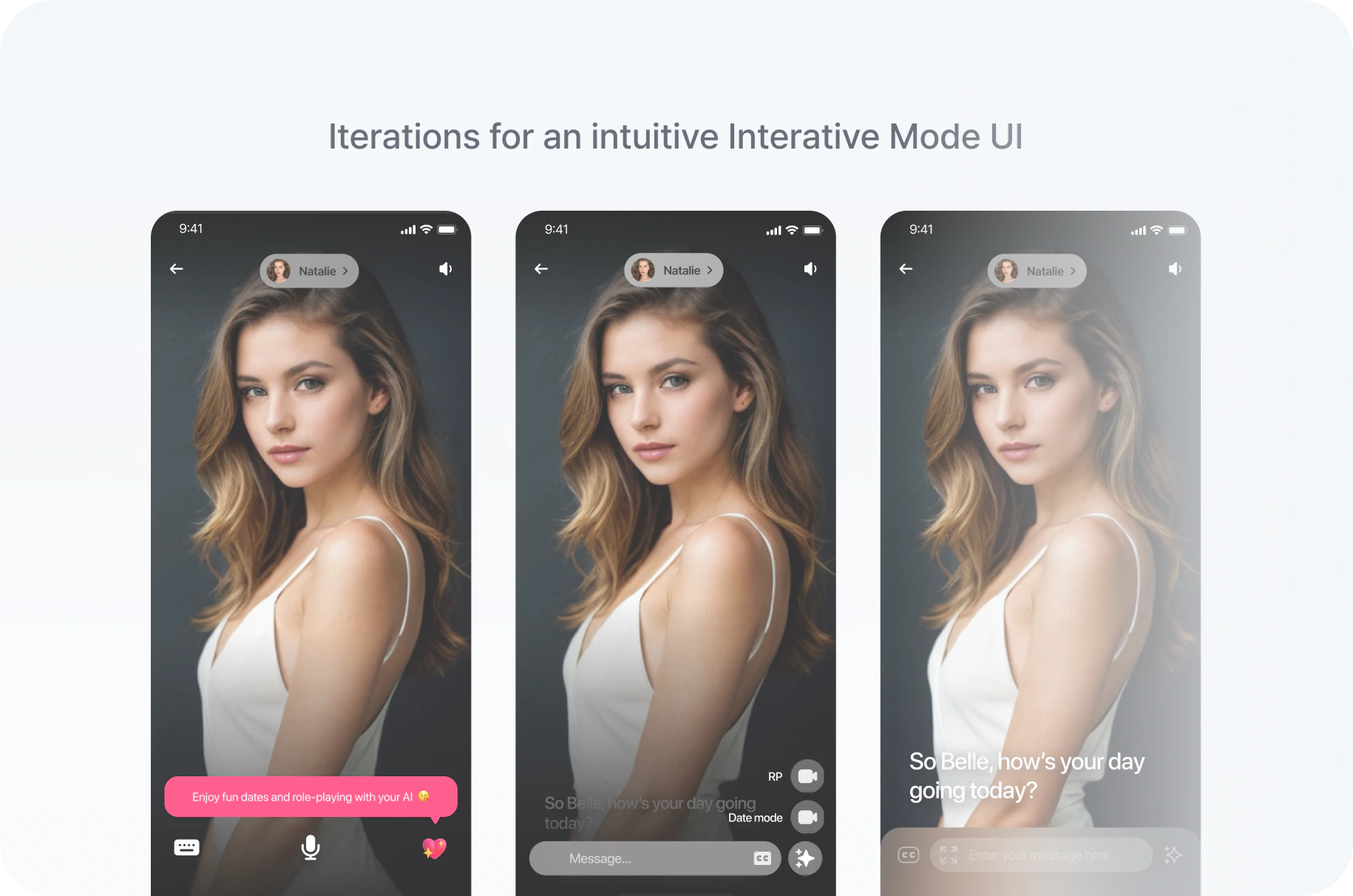
To balance seamlessness with discoverability, I explored three entry button designs and chose a curiosity-driven CTA.

OPTION A

Hidden behind an extra step
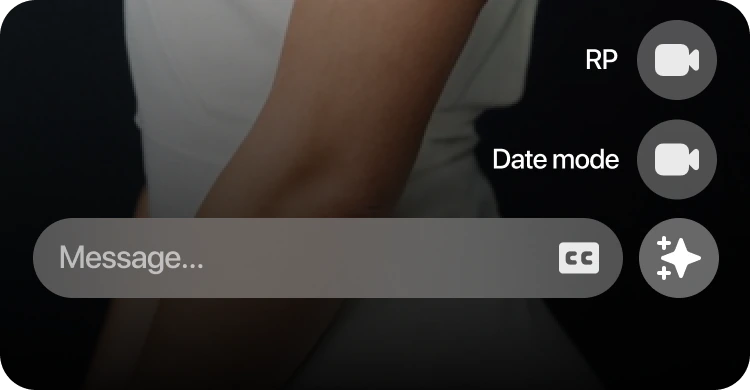
Mode menu hidden behind an extra icon

Users had to tap an unfamiliar icon
before discovering the two modes.

OPTION B

Too disruptive

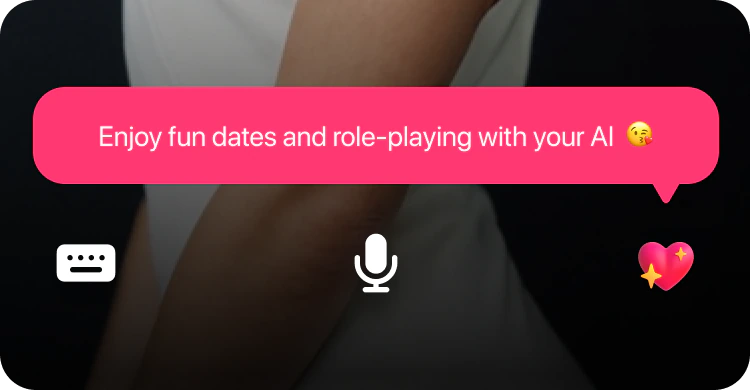
Prominent pink prompt with a heart button

The prominent prompt made the feature clear,
but competed with the conversation.

SELECTED DIRECTION

Curiosity-driven CTA

Subtle animated branded CTA

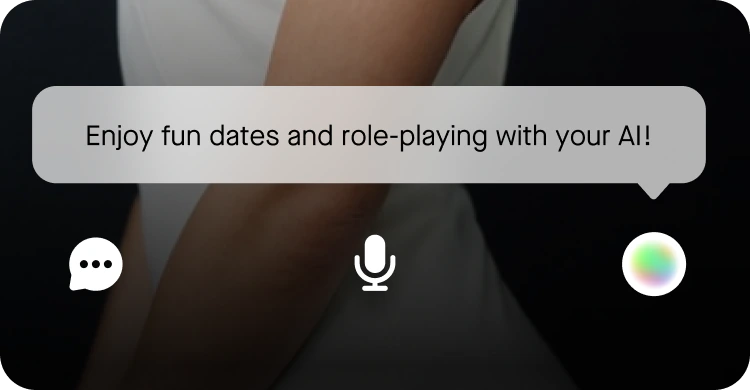
An animated, branded CTA invited exploration without interrupting the conversation.

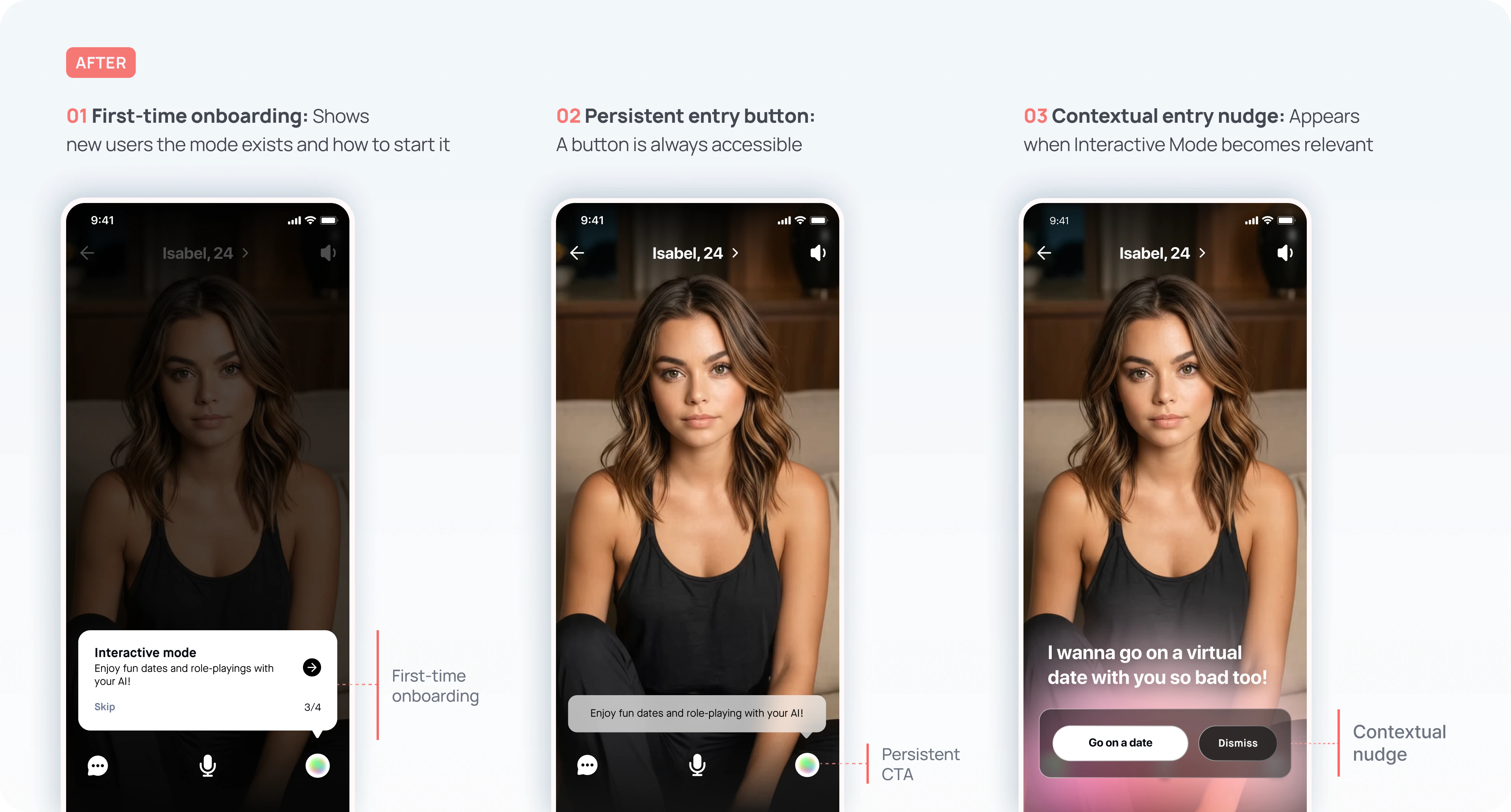
Three clear ways into Interactive Mode during a conversation

Onboarding addresses the unfamiliar pattern, the persistent button fixes low discoverability, and the contextual nudge makes the transition clear.

After: first-time onboarding, persistent entry button and contextual entry nudge
DESIGN SOLUTION 2-1: CONVERSATIONAL ENGAGEMENT

Reducing the effort to start and sustain a scenario

Describing a desired scenario through conversation was unfamiliar UX to users, making it difficult to get started. We introduced two ways to start and supported both high-intent users and users who needed inspiration.

Before: describe a whole scenario by voice. After: create your own or choose a preset
DESIGN SOLUTION 2-2: CONVERSATIONAL ENGAGEMENT

Helping users keep the conversation moving

Even after choosing a scenario, users could pause while deciding what to say next. We added context-aware suggested replies to give users an easy starting point and keep conversation flowing.

Before: users came up with their own replies. After: context-aware suggested replies

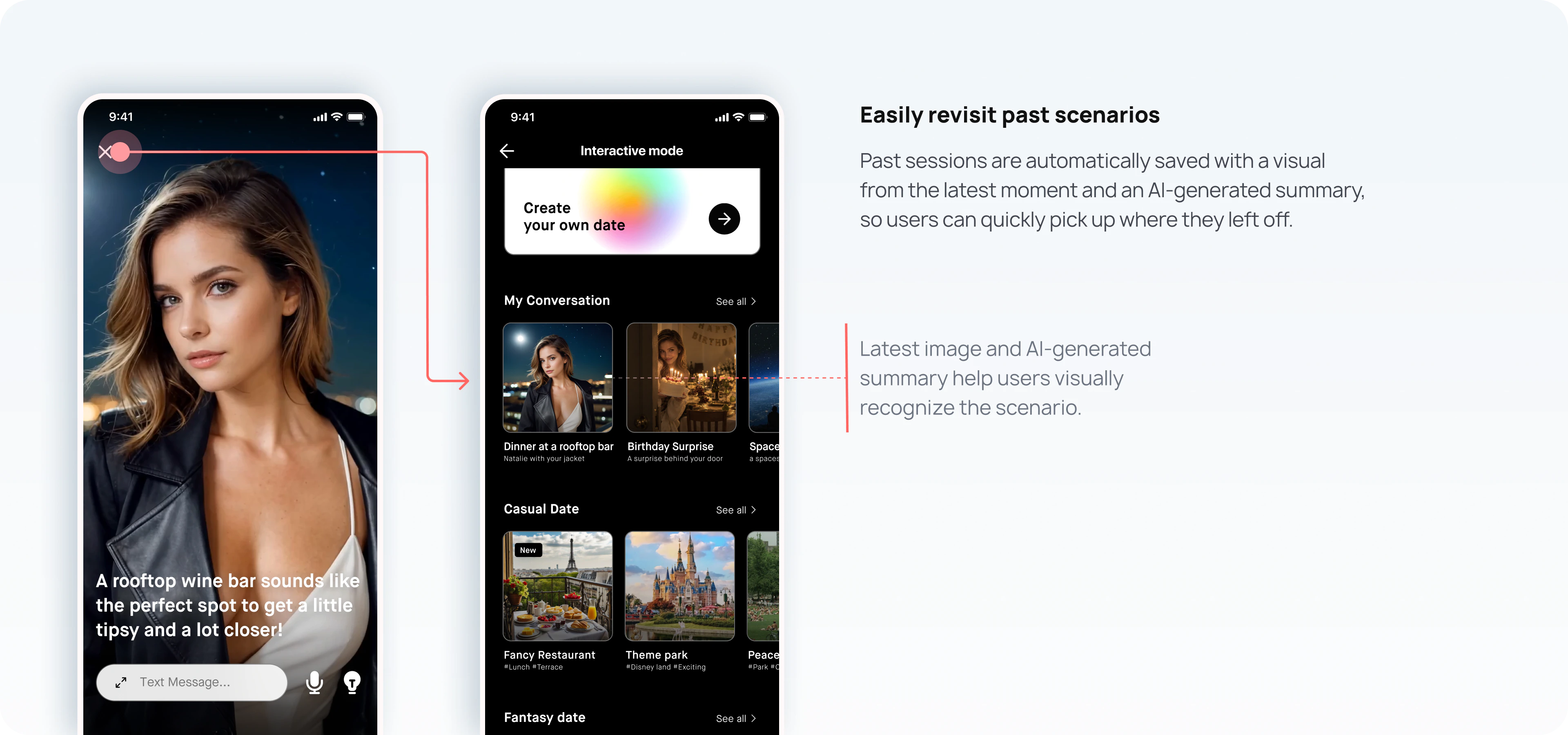
Helping users return to past conversations with context

After users left Interactive Mode, there was no clear way to return to a previous scenario. We introduced My Conversation, which automatically saves past sessions with the latest image and an AI-generated summary, making it easy for users to recognize and revisit their previous experiences.

My Conversation saves past sessions with the latest image and an AI-generated summary
RESULT

More users entered Interactive Mode and spent more time using it

Increase in entry rate

5x

13.38%→68.15%

The share of users who tried Interactive Mode immediately after entering chat rose significantly. Users also reported feeling closer to their AI partner when their shared history was remembered.

Conversation time longer

5.5x

5.4 min→29.5 min

Scenario options and suggested replies reduced pauses and helped users keep conversations moving—extending the average chat duration to nearly 30 minutes.

LESSONS LEARNED

Using data to uncover user needs behind unexpected responses

We initially assumed users wanted AI conversations to feel like real video calls, so we designed a minimal interface around that experience. However, usage remained below expectations, while behavioral data showed that users with longer conversations were more drawn to imaginative scenarios beyond everyday reality.

This taught us that in an emerging market without established mental models, design decisions must be guided by observed behavior rather than assumptions. Although time constraints prevented formal A/B testing, future iterations should validate user responses systematically to inform more impactful UX/UI decisions.

Iterations for an intuitive Interactive Mode UI